
Big Sur Fall Fest: A Regenerative Fundraising Model
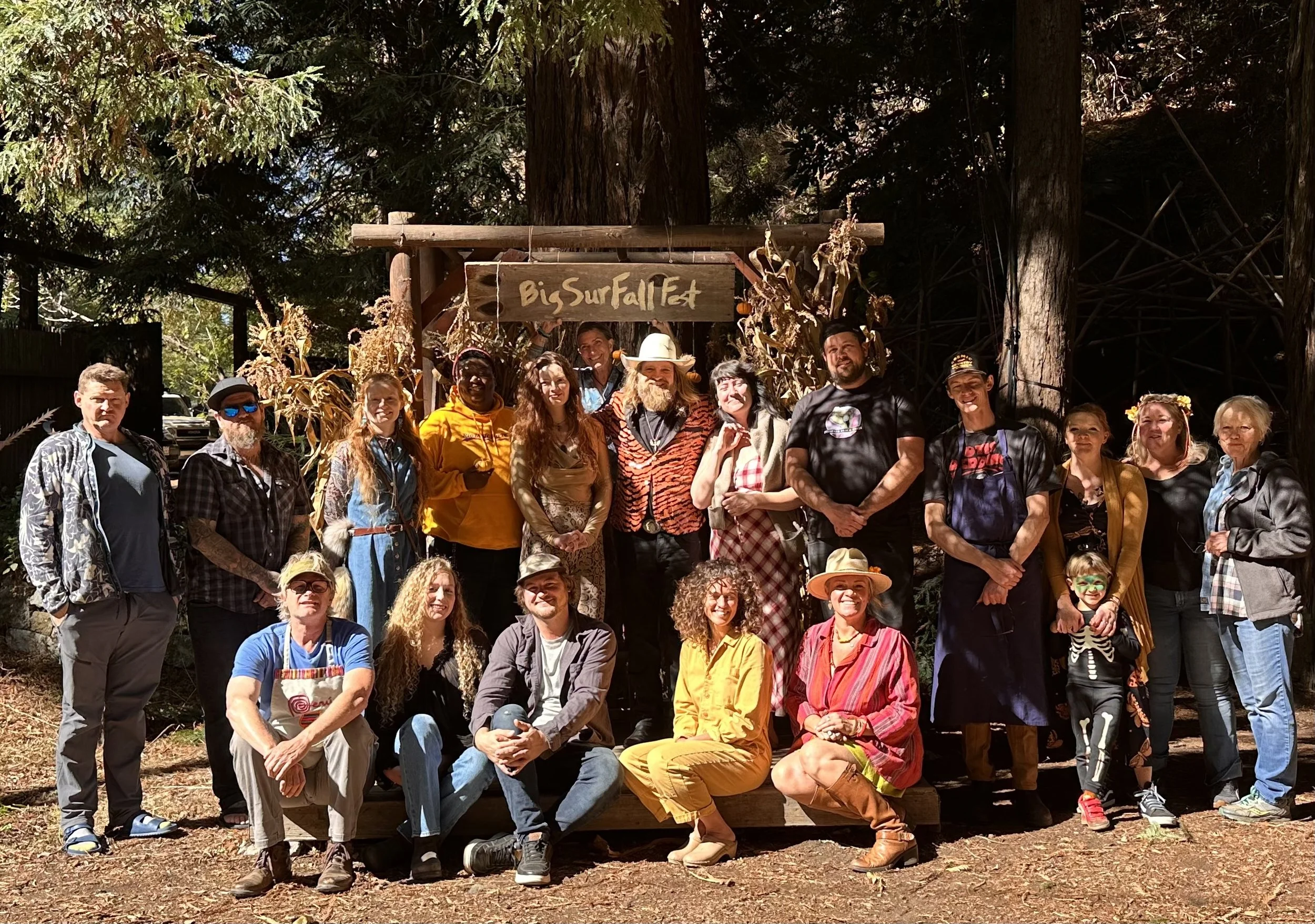
The Question:
What if a community fundraiser not only strengthened the nonprofits it supported but also the local economy that made it possible? How do you design an event where everyone involved — vendors, musicians, chefs, venues, volunteers, nonprofits, and the community — benefits?
Many fundraisers rely on donated time and donated goods. Through a regenerative fundraising model, we asked:
What would it look like to invert that entirely?
The Model:
Field + Form and co-producer Jerry Moxley designed the 2025 Big Sur Fall Fest around a circular economy:
All vendors, musicians, chefs, and the venue were paid. The event team partnered with local producers, farms, wineries and breweries, purchasing at wholesale cost to support these regional businesses. The Fall Fest hired local musicians and held the event at Henry Miller Memorial Library. People participated from a place of enthusiasm, and admission was accessible through sliding scale donations.
The event was additionally supported by sponsorships from the Arts Council of Monterey County and private donors committed to local arts and music.
The Outcome:
After paying everyone accordingly, Big Sur Fall Fest raised $3,000, split evenly between Big Sur Park School and Big Sur Big Share.
Beyond the direct donation, the model created economic circulation: money went to local farmers, regional breweries and wineries, musicians, and the venue. Big Sur Park School provides outdoor early childhood education for Big Sur children. Big Sur Big Share creates opportunities for the community to share food, support, and connection, and shows up during emergencies — wildfires, crises — getting food, supplies, and medications to residents who need them.
What This Measures:
Traditional fundraising measures success by total dollars raised. This model accounts for something often unseen: relational capacity.
Did it strengthen community bonds? Yes. Did it create fair economic opportunity? Yes. Did it keep resources flowing locally? Yes.
This is an example of what regenerative economics can look like in practice.
CA-19 Listening Series: When Institutions Listen, Dialogue on Gaza

Democratic systems depend on the ability of institutions to listen to the people they serve. When issues are emotionally charged or geopolitically complex, listening becomes difficult. Officials rely on scripted statements and constituents turn to protest and/or demands. This is where dialogue can collapse.
In mid-2025, Field + Form designed a pilot model: a trauma-informed Listening Series structured to bring a member of Congress into relationship-based dialogue with constituents on humanitarian concerns in Gaza.
The Design:
The goal was not persuasion, alignment, or policy negotiation, but instead ethical presence in the midst of crisis, grounded in the belief that democratic responsibility includes the willingness to hear one another without collapsing into defensiveness or ideological control.
The original design included closed-door sessions, curated diversity of lived experience, trauma-informed facilitation, constituent question intake, and collaborative synthesis. The emphasis was relational capacity and the ability to stay in relationship with complexity rather than retreat from it.
What Happened:
As implementation began, external pressures emerged. Scheduling challenges, procedural demands, and shifting legislative workload constrained capacity. Several elements were deferred, and ultimately Field + Form was repositioned alongside constituents rather than as primary facilitator.
This shift revealed a larger truth about government under strain: innovations may be conceptually embraced, but they are not always structurally executable. Yet the core purpose remained, and on November 3, 2025, Congressman Panetta listened to constituents. The Congressman entered with questions, asking constituents to share their concerns directly and while the conversation held intensity due to the nature of the topics, it was not adversarial.
What This Reveals:
Even in its pared-down form, this pilot demonstrated that relational space changes civic behavior. When constituents are not asked to express outrage to feel heard or compress values into demands, they speak differently. When elected officials are not pressured to defend, they have the capacity to listen differently.
Civic innovation inside government faces structural limits. Institutions have ethical responsibilities that can constrain collaboration, and this is not necessarily a failure, but a civic boundary worth honoring.
The pilot also affirmed that democracy becomes more resilient when institutions listen without defensiveness, and when constituents speak without performing conviction.
Relational capacity building is not supplementary to civic forums because it is foundational, and this is why independent civic infrastructure matters.
Esselen Tribe Harvest Fundraiser: Community Meal as Relational Practice
Field + Form's work with the Esselen Tribe of Monterey County centers on Indigenous advocacy and relational capacity building. The Autumn Harvest Fundraiser emerged as a way to honor the Tribe's nonprofit work, celebrate local community, and create sustained connection. Documentary film by Megan Alldis.
The Design:
The 2022 and 2023 Autumn Harvest Fundraisers were structured around community collaboration and intentional convening. The events brought together local nonprofits, conservation organizations, artists, musicians, schools, and community members as collaborators and supporters. Field + Form supported the vision through fundraiser design and volunteer coordination with a focus on centering the Esselen Tribe and community.
The day unfolded through opening ceremony, local music, panel discussion with conservation and cultural partners, an artist marketplace, use of an outdoor kitchen, and a family-style harvest meal followed by closing ceremony.
What This Demonstrates:
Collaborative convening requires genuine relationship-building across sectors, sustained over time, with the understanding that some conversations need annual rhythms to deepen. When an event is designed to center Indigenous participation and partnership rather than extract from it, community relationships shift. People show up differently, the capacity for trust builds and the work of cultural preservation and community care becomes visible as shared responsibility.